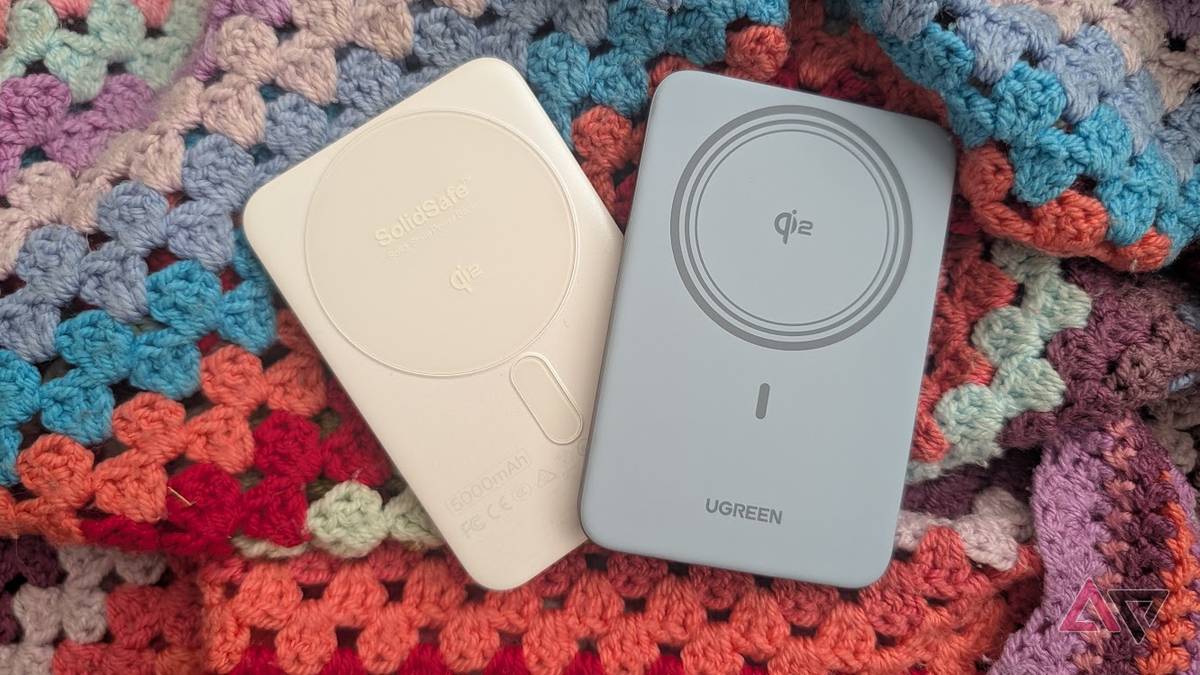
A few months ago, I received the BMX SolidSafe Air power bank. I discovered it at CES 2026 and was fascinated by the semi-solid-state technology behind it.
I tested it, was suitably impressed by its svelte figure, and started carrying it around whenever I thought I might need extra battery capacity.
However, I then received a pair of UGreen’s newest power banks. These power banks aimed to fulfill the same needs as BMX’s SolidSafe power banks, but they relied on the lithium-ion battery technology that has been the standard for decades.
I pitted the two power banks against each other to discover which one was actually the best.
Even small changes in size make a huge difference
Millimeters matter
UGreen sent me two power banks: a beefy 10,000mAh brick with attached charging cable, and a slimmer 5,000mAh version.
Both power banks offered Qi2 magnetic charging, but I focused on the smaller power bank as it was a closer match to my 5,000mAh BMX power bank.
The first notable difference is size. BMX claims that its semi-solid-state battery needs less space than lithium-ion batteries, and that’s certainly true.

The only significant difference in size was thickness. The BMX SolidSafe Air is 103mm x 70mm x 6.8mm and the UGreen MagFlow Air is 105mm x 70mm x 9mm.
While a 2.2mm difference doesn’t seem like a lot on paper, it’s the most important divergence between the two power banks.
Not only is the BMX SolidSafe Air thinner, but it features rounded edges. It never caught in my pockets. While it was impossible to ignore the extra thickness, it never interfered with using my phone.
The same could not be said for the UGreen MagFlow Air. The square-sided design made it feel like I had another phone strapped to my Google Pixel 10 Pro, and it was constantly catching in my pockets.

While both sets of magnets were equally strong, I knocked the UGreen MagFlow Air off my phone twice as much as the BMX SolidSafe Air.
It’s important to remember that the semi-solid-state technology makes BMX’s thinner power banks possible. While I would have liked to see rounded edges on the UGreen MagFlow Air, UGreen could not have done anything to make it thinner.
Surprisingly, both power banks charged equally effectively
Semi-solid-state technology won’t charge your phone faster
To test each power bank’s charging capabilities, I drained my phone’s battery before attaching a full power bank and using my phone as normal. I repeated this process three times for each power bank.
|
Total charge |
||||
|---|---|---|---|---|
|
Test 1 |
Test 2 |
Test 3 |
Average |
|
|
BMX |
43% |
46% |
47% |
45.3% |
|
UGreen |
52% |
44% |
47% |
47.6% |
A 2.3% charge difference is something, but not enough for me to recommend one power bank over another solely on charging capacity.
Both power banks had a maximum power output of 20W, and drained their batteries in roughly four hours each time.
What was more interesting was the heat generated during testing. BMX claims that its SolidSafe technology is safer, and I’ve seen plenty of nails hammered through its power banks to believe its claim.
However, I (and I suspect you) don’t go around hammering nails into power banks.

While charging my phone with each power bank, I measured the temperature of my phone and the power bank to see if there was any danger created from the heat generated.
During charging, my phone increased in temperature from roughly 34 °C / 93.2 °F to 42.2 °C / 107.96 °F. Hot, but not dangerously so.
However, the BMX SolidSafe Air’s external temperature topped out at 38 °C while the UGreen MagFlow Air reached 41.3 °C.
Both power banks were uncomfortable to hold while charging, but the UGreen device felt more uncomfortable to hold despite the minor difference in external temperatures, likely due to the materials used in construction.
It’s easy to see which battery technology is superior
But a sale would make me switch

Both power banks retail for $60, so choosing between them is a no-brainer.
Thanks to its semi-solid-state battery, the BMX SolidSafe Air is thinner, lighter, and cooler than UGreen’s MagFlow Air. However, the MagFlow Air is an excellent power bank.
I kept both power banks attached until their charge was depleted for testing, but during regular use, I would detach them when the heat got uncomfortable and resume charging later.
5,000mAh is theoretically enough to charge my Pixel 10 Pro from 0% to 100% if turned off, but I use power banks this size for quick top-ups when needed. In this scenario, I would be happy to carry either one around.
Semi-solid-state batteries have clear advantages over lithium-ion batteries. However, lithium-ion power banks are still effective.
I think we’ll see a slow shift towards solid-state or semi-solid-state batteries in the years to come, but for now, there isn’t enough of a difference for a seismic shift.
PakarPBN
A Private Blog Network (PBN) is a collection of websites that are controlled by a single individual or organization and used primarily to build backlinks to a “money site” in order to influence its ranking in search engines such as Google. The core idea behind a PBN is based on the importance of backlinks in Google’s ranking algorithm. Since Google views backlinks as signals of authority and trust, some website owners attempt to artificially create these signals through a controlled network of sites.
In a typical PBN setup, the owner acquires expired or aged domains that already have existing authority, backlinks, and history. These domains are rebuilt with new content and hosted separately, often using different IP addresses, hosting providers, themes, and ownership details to make them appear unrelated. Within the content published on these sites, links are strategically placed that point to the main website the owner wants to rank higher. By doing this, the owner attempts to pass link equity (also known as “link juice”) from the PBN sites to the target website.
The purpose of a PBN is to give the impression that the target website is naturally earning links from multiple independent sources. If done effectively, this can temporarily improve keyword rankings, increase organic visibility, and drive more traffic from search results.